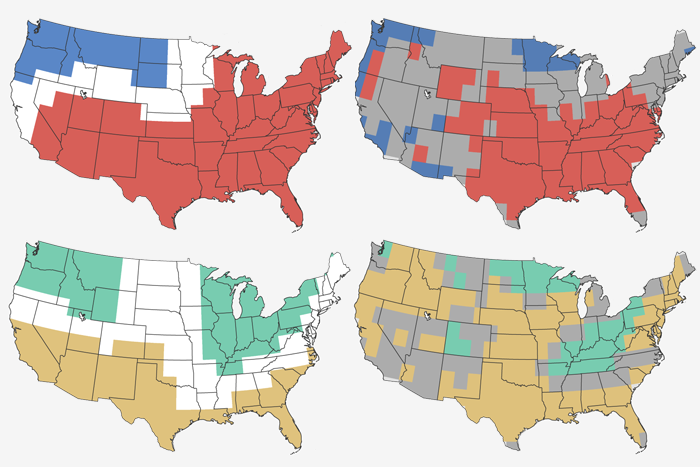
How well did the 2021-2022 Winter outlook do? Pretty well if you ask me! Chalk up another year in a track record of outlooks performing better than random chance.
A new study conducted in Wisconsin indicates that low, fair-weather, cumulus clouds stimulate stronger surface energy exchange in comparison to other sky conditions over a forested landscape.
When does the chance of an overnight freeze drop below 50 percent? Explore this map to find out.
In the tropical Pacific, year-to-year changes in chlorophyll is dominated by the El Niño-Southern Oscillation. El Niño can sharply reduce the regional supply of nutrients, limiting phytoplankton growth. GFDL’s new Earth System Model captures not only the onset and extent of chlorophyll anomalies during El Niño events, but also a pronounced post-El Niño “chlorophyll rebound” that produces positive equatorial Pacific chlorophyll anomalies in the summer following El Niño events.
The Northeast Pacific Ocean has experienced multiple marine heatwaves. One notable marine heatwave, nicknamed the Blob, lasted from the winter of 2013–2014 through mid-2016. A new study indicates that specific ocean surface conditions may help scientists predict Northeast Pacific marine heatwaves months in advance.
Flood risk in Upper Midwest, Midwest and Southeast.
It was the seventh-warmest February on record going back to 1880, and it is virtually certain 2022 will wind up one of the ten warmest years on record, despite the cooling influence of La Niña.
The Atlantic Meridional Overturning Circulation (AMOC) is a key component of global climate. A new study shows that, since 1980, AMOC has had periods of strengthening and weakening, although the magnitudes of change are uncertain.
It's too soon to tell whether this winter's double-dip La Niña will become next winter's three-bean salad. But our blogger tells us what's on the menu this spring.
Below-average precipitation across the West led to an expansion of drought.