NOAA has released the first report in a monograph series on climate adaptation, titled “Our Changing Precipitation: A Conversation on the Science of Precipitation and Planning for the Future.” The report synthesizes information, experiences, and lessons learned.
For the first time, the U.S. Environmental Protection Agency (EPA) has included a comparison of NOAA’s atmospheric emission estimates of four hydrofluorocarbons (HFCs) to its own inventory-based estimates. The information is available in the just-released “U.S. Inventory of Greenhouse Gas Emissions and Sinks.”
Ocean waters can acidify by absorbing anthorpogenic carbon emissions, and Arctic regions are particularly vulnerable to rapid pH changes. A new study shows that unsupervised machine learning can identify distinct clusters of surface acidification in the Arctic.
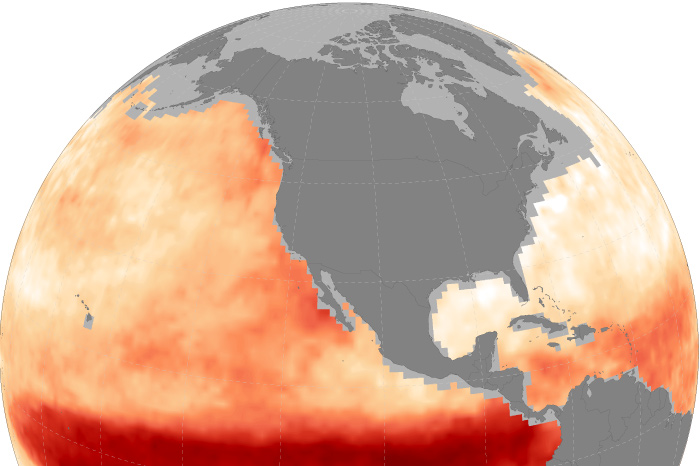
Forecasts provide an opportunity for us to reduce other stress on ocean life and prepare communities for economic impacts.
New research has shown the presence of solid organic-coated ammonium sulfate particles in the Arctic boundary layer. The particles, which should have been liquid, were solid. Solid aerosols have the potential to change how clouds form. With a loss of Arctic sea ice, researchers expect to see more particles affecting clouds and climate.
The same processes that emit carbon dioxide often emit pollutants that harm air quality: nitrogen oxides, sulfur oxides, carbon monoxide, and particulate matter. A new study finds that carbon-mitigation policies that don’t account for co-emitted pollutants may worsen air quality and raise mortality rates.
By examining “humid heat,” wet-bulb temperature more accurately assesses the human health effects of heat than measurements of temperature alone. A new study finds that wet-bulb temperatures increased in most land regions over 1979–2019.
NOAA postdoc Nastassia Patin recounts her journey aboard a French schooner in January and February 2022. The mission’s goal was to characterize, quantify, and model Atlantic Ocean ecosystems.
Climate simulations from multiple models indicate that future changes in the patterns and frequency of tropical cyclone genesis will largely be governed by human-induced changes in atmospheric circulation.
Prediction and Research Moored Array in the Tropical Atlantic (PIRATA) aims to improve predictability of ocean-atmosphere interactions in the tropical Atlantic. The PIRATA Northeast Extension (PNE) recently deployed buoys into the northeastern reachers of the tropical Atlantic Ocean. Follow the journey through this story map.