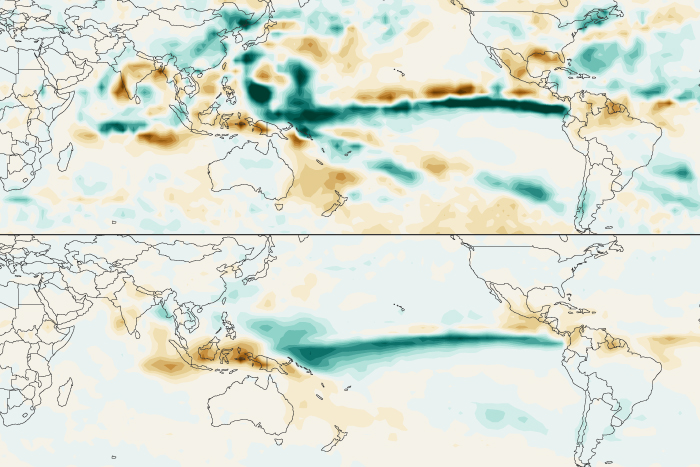
The September 2023 ENSO Outlook predicts El Niño will stick around at least through January-March 2024. But don't just take it from us, hear directly from the Pacific Ocean and tropical atmosphere, who join the blog to answer some questions.
As Hurricanes Franklin and Idalia strengthened in late August, NOAA scientists collected critical data from the air, sea surface, and underwater to enhance forecasts and increase scientific knowledge.
Predictions of temperature, precipitation and other changes in a warming world rely largely on model simulations that often render diverging results when presented in map view. By showing data in a behavioral phase space, patterns become apparent.
On September 6, 2023, FEMA announced its designation of 483 Community Disaster Resilience Zones. These zones will build disaster resilience across the nation by driving federal, public and private resources to the most at-risk and in-need jurisdictions.
A new study finds that how much of Earth’s surface energy is used to evaporate water is a crucial driver of local weather variations during summer months. The researchers identify two feedback regimes related to evaporation and cloudiness.
A third year of La Niña, a record-setting underwater volcanic eruption, and drought expansion. These are just a few of the highlights of the State of the Climate 2022 report.
A commercial vessel deployed five autonomous profiling Argo floats Institution in early August during a southbound transit from Louisiana to Jamaica. The floats will add to the global Argo array and enhance key ocean measurements in a region critical for accurate hurricane forecasting.
Recent decades have shown enhanced low sea level pressure from North Carolina to Massachusetts, associated with a relative sea level rise. This pattern combines with wind stress in the summertime and the effect grows larger over time.
A new study finds that changes in heat transport by the Atlantic Meridional Overturning Circulation (AMOC) is influencing the frequency of floods along the United States southeastern coast.
The predicted combination of a much warmer than average and much drier than average September across the country's middle is bad news for the ongoing drought in the Plains and Deep South.