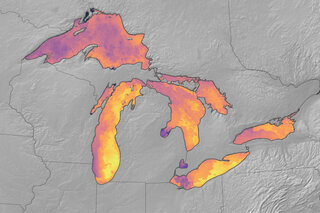
Released in 2023, the Fifth National Climate Assessment (NCA5) includes an Art × Climate gallery. This work by Nikki Way is a reflection of their fear and uncertainty around climate change in the Great Lakes region.
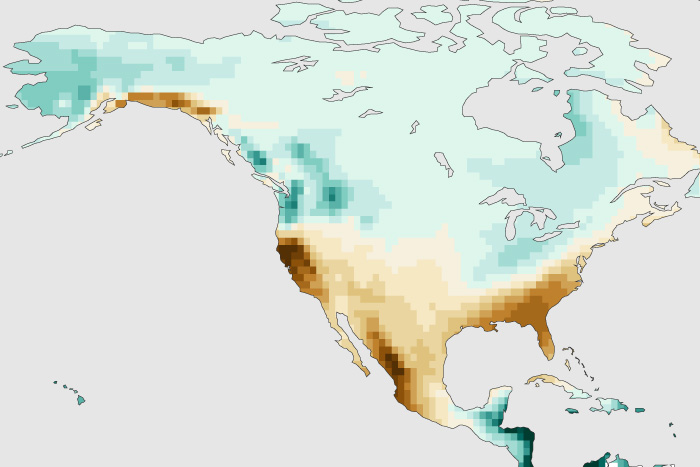
Big things sometimes come in small packages, and our blogger explains why this winter’s expected weak La Niña might have a bigger precipitation impact than usual.
Though many aspects of nature in the Northern Hemisphere tend to quiet down during the winter, the stratospheric polar vortex in the Arctic is just getting started.
November 30 marks the official end of the 2024 Atlantic hurricane season. Throughout this active season, NOAA scientists set new records in tropical cyclone research.
NOAA has announced a new agreement to support evaluation of whether the ocean can safely remove and store billions of tons of carbon dioxide.
A new analysis found that ozone pollution readings in the Upper Midwest caused by massive Canadian wildfires in spring 2023 were the worst in decades.
Rare observations of surface currents in the Bay of Bengal will help scientists understand when an ocean current may veer in a direction opposite to what they expect.
New research indicates that year-to-year hurricane variability has already increased, and projects a further 36 percent increase by the middle of the 21st century.
The Air Quality and Community Health Research Subcommittee of the National Science and Technology Council has just published a website on air quality and human health.