NOAA has invested in 23 small businesses developing innovative technologies in technical areas including climate adaptation and mitigation, weather-ready nation, healthy oceans, and resilient coastal communities and economies.
August 2022 drew to a close the third-warmest summer on record for the contiguous United States.
It's all but a done deal: odds of La Niña this winter are higher than 90 percent. Plus a reminder list of why we care so much about La Niña.
Multidecadal variability of Atlantic Meridional Overturning Circulation (AMOC) has been reconstructed by proxies, simulated in climate models, and linked to Arctic salinity variability. Still, some aspects of the AMOC have eluded understanding from a theoretical perspective. A new model may help.
Methane ice, or methane hydrates, represent vast reserves of natural gas, which can play a part in global carbon cycling and climate change. Methane hydrates have eerie inhabitants, and a new paper describes the worms’ microbial diversity for the first time.
When thinking about drought and heatwaves, it is natural to focus on the western contiguous United States. But an ongoing drought has also struck the Northeast. A new study examines how climate change may affect droughts in that region.
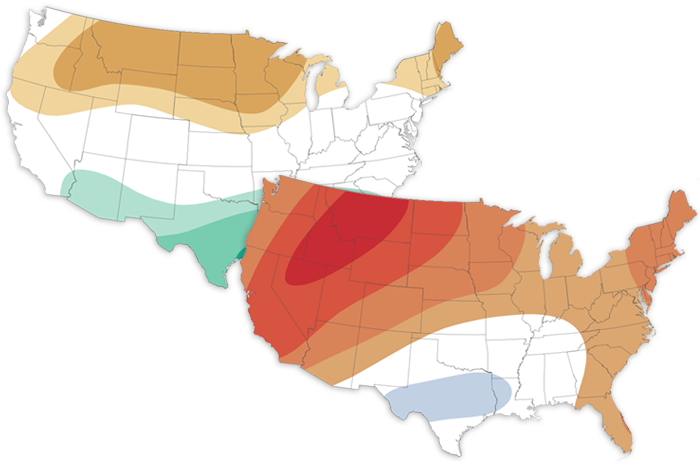
The September 2022 climate outlook favors a warmer-than-average month for most of the contiguous United States along with a dry/wet split between the northern and southern tiers of the U.S.
Global surface temperature was among the 6 warmest years on record, despite a "double-dip" La Niña event that chilled the Pacific much of the year.
An international team has collected a high-resolution bathymetric and hydrothermal plume survey of the post-eruption caldera. Employing an uncrewed surface vessel, the survey was conducted by scientists and engineers across the globe.
In 2022, mid-latitude ozone-depleting gases fell halfway back to their 1980 levels. The reduction marks a major milestone because ozone depletion was not significant prior to 1980.