  • Home
  • News & Features
  • Maps & Data
  • Teaching Climate
  • About
  • Contact
  • FAQs
  • Site Map
  • What's New?
  • El Niño & La Niña

Climate news, stories, images, & video (ClimateWatch Magazine)

  • News
  • How the Climate System Works
  • Climate Change & Global Warming
  • Natural Climate Patterns
  • Climate Impacts
  • Observing & Predicting
  • Policy & Planning
  • Extreme Events
  • Home
  • News & Features
  • Images & Video
  • Spring is arriving earlier in National Parks
Spring is arriving earlier in National Parks

Author: 
Kathryn Hansen (NASA Earth Observatory)
April 9, 2018
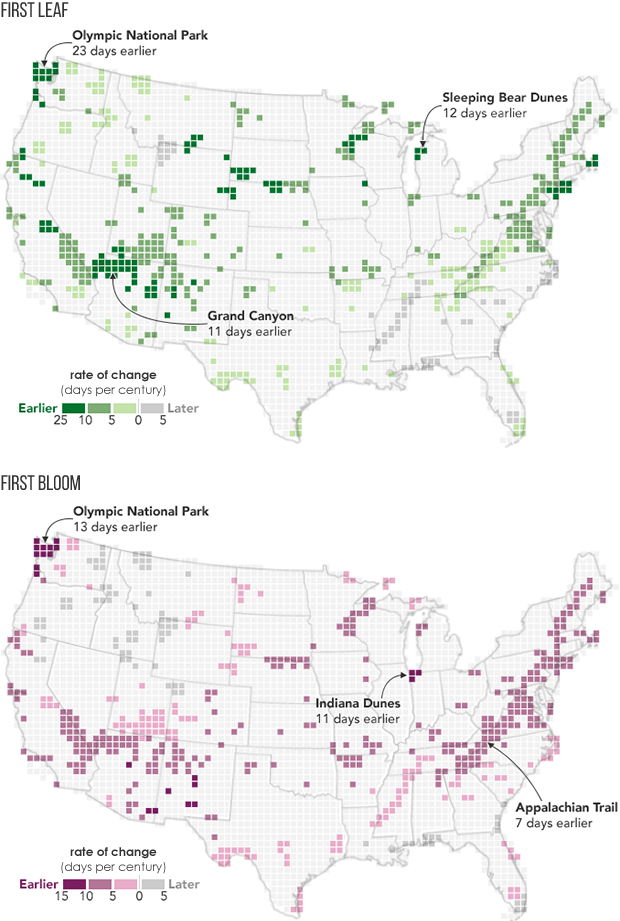
Two maps of the CONUS showing changes in emergence of first leaf (top, shades of green) and first flower (bottom, shades of pink).

eo_spring_natlparks_2016_620.png

Image Credit: 
Josh Stevens (NASA Earth Observatory)
Share This: 
Topics: 
Ecosystem Changes
Economic Impacts
Category: 
Climate Change & Global Warming
Climate Impacts
Observing & Predicting
Department: 
Images & Video

This post is excerpted from an article published by NASA’s Earth Observatory.

This spring, the cherry trees around the Tidal Basin, southwest of the National Mall in Washington, D.C., are reaching peak bloom in early April 2018—timing that is in line with the 96-year average. After a warm February, cool March temperatures confounded models that had predicted the bloom to occur earlier than usual. That’s not surprising, as temperature plays a crucial role in bloom timing.

But over the longer term, climate change is causing spring to begin earlier and earlier across the United States. These maps reveal just how much earlier spring is arriving in National Parks across the country. The data were published in 2016 by ecologists from the National Park Service, working in collaboration with colleagues at other agencies and institutions.

The first map shows the rate of change (days per century since 1901) of “first leaf”—the date at which leaves first appear from buds. The second map shows the same rate of change for “first bloom,” the average date when blooms appear. Combined, the two indices provide a way for ecologists to identify how vegetation is responding to warming temperatures.

Of the 276 parks in the study (including Alaska, not pictured), about three-quarters of them are experiencing earlier springs. More than half are experiencing “extreme” early springs; that is, recent springs are among the earliest ever observed—and in many cases are wholly unprecedented—compared to the past 112 years. The charts below show that indeed, the vast majority of parks are experiencing first leaf and first bloom earlier than usual. This means that most parks are already experiencing and responding to climate-driven changes.

To learn about the implications of these change for park ecosystems and staff (and for larger versions of the maps), read the full story at NASA’s Earth Observatory.

Related

Climate & the crowds at national parks

July 22, 2015

Counting Blossoms along a Canyon Trail

April 15, 2010

2017 Arctic Report Card: Warm summers challenge Bering Sea pollock

December 12, 2017
Boiled Lobster Plate

Climate & Lobsters

October 6, 2016

You Might Like

Portion of a map showing Arctic ocean chlorophyll concentrations in July 2020

Sea ice withers while phytoplankton blooms in the Arctic

December 4, 2020
Side by side maps of the range of various fish groups in the Bering and Barents Seas

2019 Arctic Report Card: At gateways to the Arctic, northern fish are retreating

December 10, 2019

Great Lakes ice cover decreasing over last 40 years

July 9, 2018
Lobster Catch Distribution 2014

Warming ocean temperatures push lobster populations north

December 22, 2016

climate.gov

  • Home
  • News & Features
  • Maps & Data
  • Teaching Climate
  • About
  • Contact
  • FAQs
  • Site Map
  • What's New?

Follow Climate.gov

Follow us on twitter
Follow us on Facebook
Follow us on Instagram

Subscription link to sign up for Climate.gov's weekly update newsletter

2014 Webby Award winning website

Webby Award Webby Award

Click each award to learn more

  • Information Quality
  • NOAA Freedom of Information Act
  • Privacy Policy
  • Disclaimer
  • USA.gov
  • ready.gov